Tooth loss can affect chewing, speech, and confidence. When a tooth is missing, many people want a long-term solution that restores comfort and function while protecting overall oral health.
Modern dentistry offers several advanced treatments for replacing missing teeth. While no restoration can guarantee lifelong results, some options are designed to provide exceptional durability and stability. Understanding how these treatments work can help you choose the right solution for your smile.
Several treatments can replace missing teeth permanently or semi-permanently. Each option offers different benefits depending on oral health, bone support, and long-term treatment goals.
Key Takeaways
|
Types of Permanent Tooth Replacement
Dentists recommend different treatments depending on:
- How many teeth are missing
- The condition of the surrounding teeth and gums
- Whether there is enough bone to support implant placement.
The most common permanent tooth replacement options include:
1. Dental Implants
Dental implants are widely considered the most durable tooth replacement option. Research reports implant survival rates of approximately 99% over 10 years when properly maintained. Additional prosthodontic studies show many implants remain successful for 15 to 20 years or longer with good oral hygiene and regular dental visits.
Dental implants replace both the visible tooth and the tooth root. The Canadian Dental Association explains that dental implants replace missing tooth roots and support artificial teeth that function similarly to natural teeth. At the same time, they also help preserve jawbone structure.
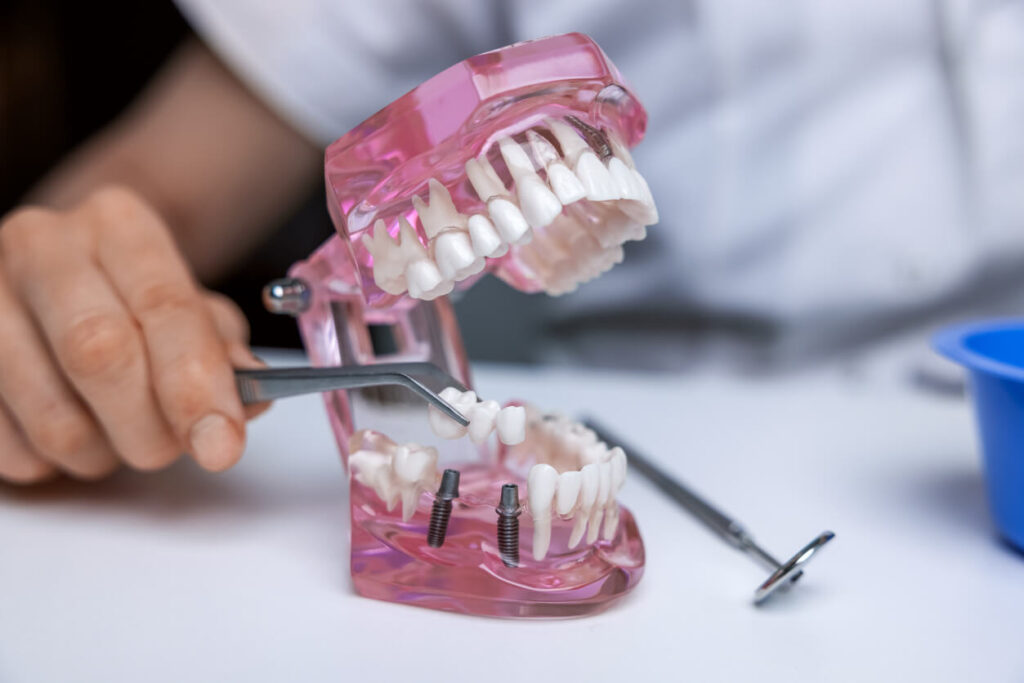
Dental implant surgery involves placing small titanium implant posts into the jawbone beneath the gums. After the healing process, a new artificial tooth is attached to the implant, creating a stable and natural-looking restoration.
Pros of Dental Implants
- Replace missing teeth without affecting nearby teeth
- Help reduce bone loss in the jawbone
- Function and feel similar to natural teeth
- Provide strong chewing ability
- Can replace a single tooth or support multiple teeth
Cons of Dental Implants
- Require minor surgical placement and healing time
- May require bone grafting if bone support is limited
- Higher upfront cost compared to bridges or dentures
- Healing process may take several months
- Not all patients qualify due to gum disease or certain health conditions
2. Dental Bridge
A dental bridge is a tooth replacement solution used when one or more teeth are missing. A fixed bridge replaces missing teeth by anchoring an artificial tooth to neighboring teeth.
Bridges restore appearance and chewing ability but rely on nearby teeth for support. They are often recommended when implant surgery is not suitable or when patients prefer a faster, non-surgical option.
Clinical research shows bridge survival rates may reach approximately 82% at 10 years, depending on oral hygiene and maintenance.
Pros of Dental Bridges
- Do not require implant surgery
- Typically completed faster than dental implant procedures
- Effective solution for replacing one or more teeth
- Often more affordable than implants
- Provide a stable chewing function and appearance
Cons of Dental Bridges
- Require reshaping neighboring teeth to support the bridge
- Do not replace the tooth root, which may contribute to bone loss over time
- Lifespan is generally shorter than dental implants
- Supporting teeth may develop tooth decay or damage over time
- May eventually need to be replaced
Bridges can still provide durable results when patients maintain healthy teeth and gums and attend regular dental check-ups.
3. Implant-Supported Dentures
Implant-supported dentures replace multiple missing teeth by anchoring replacement teeth securely in the jawbone with dental implants. These dentures attach to implant posts instead of resting directly on gum tissue. They provide greater stability and chewing strength.
Studies show implant-supported dentures have strong long-term durability. The survival rate exceeds 90% after 10 years when implants are properly maintained. Additional clinical research indicates implant-supported full-arch restorations can remain successful for 15 years or longer with regular dental monitoring and good oral hygiene.
Pros of Implant-Supported Dentures
- Provide greater stability than removable dentures
- Improve chewing ability and speech comfort
- Help reduce jawbone shrinkage caused by tooth loss
- More secure fit with less movement during eating or speaking
- Can replace multiple teeth or full arches
Cons of Implant-Supported Dentures
- Require implant surgery and healing time
- Higher initial cost than traditional dentures
- May require bone graft procedures if bone loss is present
- Require regular dental visits to monitor implants
4. Traditional Dentures
Traditional dentures are removable appliances designed to replace several teeth or to serve as complete dentures when all teeth are missing. These dentures rest directly on gum tissue rather than replacing the tooth root.
Research shows that traditional dentures typically last 5 to 10 years before needing replacement or adjustment due to changes in gum tissue and bone structure. Over time, dentures may loosen as the jawbone naturally shrinks after tooth loss, affecting comfort and stability.
Pros of Traditional Dentures
- Non-surgical tooth replacement option
- Lower upfront cost compared to implant treatments
- Suitable for patients with significant bone loss or medical limitations
- Can restore appearance and basic chewing function
Cons of Traditional Dentures
- May shift or move while eating or speaking
- Do not prevent jawbone shrinkage
- Require periodic relining, adjustment, or replacement
- Often feel less natural than implant-supported restorations
Factors That Determine Which Treatment Fits You
Choosing the right tooth replacement treatment depends on several personal and clinical factors. Dentists evaluate these carefully to recommend the safest and most durable option for long-term oral health.
Bone and Gum Health
Healthy gums and a strong jawbone are essential for long-term treatment success. Dental implants require sufficient bone to support them securely. If bone loss has occurred, procedures like bone grafting may be needed. Untreated gum disease can also increase the risk of restoration failure, regardless of the treatment selected.
Number of Missing Teeth
The number and location of missing teeth help determine which treatment works best. A single missing tooth may be replaced with a dental implant or fixed bridge. When several teeth or an entire arch is missing, implant-supported or traditional dentures may be recommended to restore chewing ability and appearance.
Lifestyle and Oral Health Habits
Smoking, teeth grinding, and poor oral hygiene can affect the longevity of restorations. These habits can slow healing, increase pressure on replacement teeth, and raise the risk of gum disease or infection. Dentists may recommend protective devices or hygiene adjustments to improve treatment outcomes.
Preventive Dental Care
Regular dental check-ups and cleanings play a major role in protecting replacement teeth. Routine visits allow dentists to monitor restorations, detect problems early, and help patients maintain healthy teeth and gums for long-term success.
Tips to Help Permanent Replacement of Tooth Last Longer
Canadian oral health authorities emphasize that daily hygiene and professional monitoring are among the strongest predictors of long-term restoration success. Patients can help protect replacement teeth by:
- Brushing and flossing daily
- Visiting the dentist regularly for cleanings and exams
- Wearing night guards if grinding occurs
- Avoiding tobacco products
- Treating gum disease early
- Following post-surgery instructions carefully
Restore Your Smile With Care You Can Trust
At Wheatland Dental, patients receive comprehensive, patient-focused care designed to support long-term oral health and confident smiles. As a locally owned and operated dental clinic serving Saskatoon and Watrous, Wheatland Dental provides a full range of services. These include preventive cleanings and check-ups, as well as advanced treatments such as dental implants, orthodontics, and cosmetic dentistry, all delivered in a welcoming, comfortable environment. Their experienced dental team uses modern technology and personalized treatment plans to help patients choose the best long-term solution for replacing missing teeth.
Whether you want to replace a missing tooth, improve your oral health, or explore advanced tooth replacement options, Wheatland Dental makes care convenient with flexible scheduling, direct billing options, and two accessible Saskatchewan locations.
Contact Wheatland Dental today to schedule your consultation and take the next step toward restoring your smile with confidence.